Virtual Environments with Eglot, Tramp, and Pyright
Motivation
My most reliable setup for developing Python projects on remote hosts with LSP
support so far has been with
eglot and
pyright. I’ve also tried
lsp-mode with
pyright, and both of lsp-mode and
eglot with the
python-lsp-server, however I’ve landed on eglot + pyright for a few
reasons:
-
eglotrequires zero configuration to work over Tramp, unlikelsp-mode. - Fewest number of Tramp hangs. This could just be a symptom of my particular setup, though.
-
eglotwill have built-in support in future Emacs versions. This may or may not be worth a damn to other Emacs users. -
pyrighthas been strictly faster at error checking and diagnostic updates as compared topython-language-serverin the machines I’m using.
One hiccup remained though: pyright is typically a system or user
installation, not something you install per virtual environment. Getting
pyright to see the virtual environment of my choosing , and
correctly report which dependencies are installed was a bit of a hassle, but I
think my favorite solution so far has been to configure the virtual
environment through the pyrightconfig.json file at the root of my
project, and just have this file ignored by git. Typically,
pyrightconfig.json looks like this:
{
    "venvPath": "/absolute/path/to/dir/",
    "venv": ".venv"
}
I’m pretty happy with the other default configurations for
pyright, so I leave those be, and just configure the virtual
environment path this way. What was annoying me, though, is that I’d need to
write out this absolute path for each machine I clone a project into, since
relative paths and shortcuts using ~ aren’t supported. Much
better if we can just have Emacs do it for us.
In the spirit of other Emacs/Python tools like pythonic and
pyvenv for activating virtual environments, I wanted something
that would just prompt for a directory using completing-read, and
then populate the contents of pyrightconfig.json automatically
based on my selection.
Getting Functions That Write pyrightconfig.json
Edit 2022-11-20: Thanks to Mickey Petersen of
mastering emacs for pointing out
that json-encode exists. I originally had my own function
pyrightconfig--json-contents here, but I’ve modified the function
below to use this built-in version instead.
We really just need to do three things:
- Prompt for a directory that houses a Python virtual environment
- Break the result into an absolute parent path + base name, cleaning any Tramp prefix in the process
-
Write the contents of
pyrightconfig--json-contentsusing the previous result to a file in the version control root.
It’s worth mentioning that we must put this file in the VC root,
otherwise eglot just won’t pick it up. For my purposes, the VC
system will always be git, so I’m going to make an assumption here and use
vc-git-root instead of something more generic.
(defun pyrightconfig-write (virtualenv)
  (interactive "DEnv: ")

  (let* (;; file-truename and tramp-file-local-name ensure that neither `~' nor
         ;; the Tramp prefix (e.g. "/ssh:my-host:") wind up in the final
         ;; absolute directory path.
         (venv-dir (tramp-file-local-name (file-truename virtualenv)))

         ;; Given something like /path/to/.venv/, this strips off the trailing `/'.
         (venv-file-name (directory-file-name venv-dir))

         ;; Naming convention for venvPath matches the field for
         ;; pyrightconfig.json.  `file-name-directory' gets us the parent path
         ;; (one above .venv).
         (venvPath (file-name-directory venv-file-name))

         ;; Grabs just the `.venv' off the end of the venv-file-name.
         (venv (file-name-base venv-file-name))

         ;; Eglot demands that `pyrightconfig.json' is in the project root
         ;; folder.
         (base-dir (vc-git-root default-directory))
         (out-file (expand-file-name "pyrightconfig.json" base-dir))

         ;; Finally, get a string with the JSON payload.
         (out-contents (json-encode (list :venvPath venvPath :venv venv))))

    ;; Emacs uses buffers for everything.  This creates a temp buffer, inserts
    ;; the JSON payload, then flushes that content to final `pyrightconfig.json'
    ;; location
    (with-temp-file out-file (insert out-contents))))
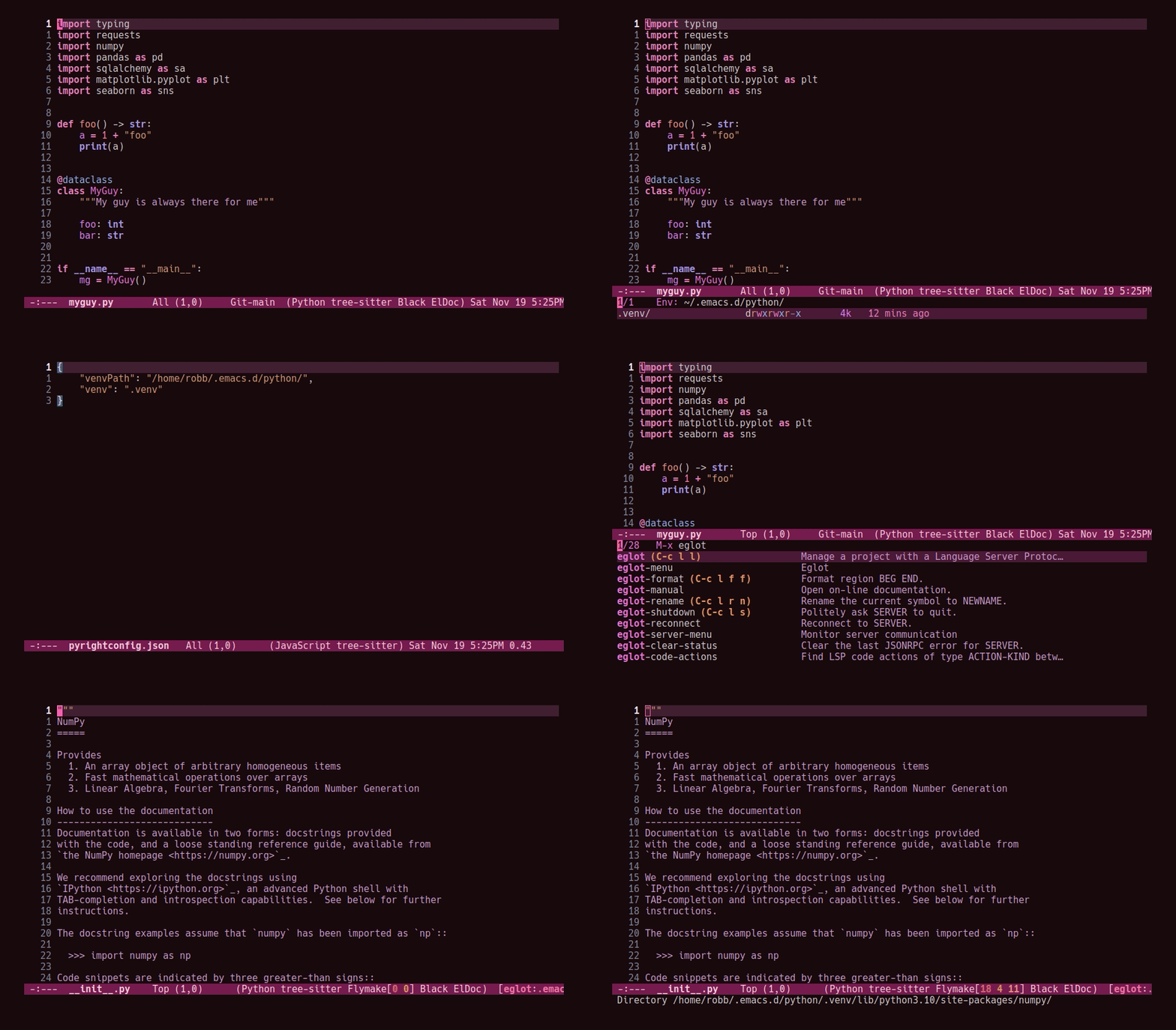
Here’s a quick demo where I interactively choose a virtual environment
directory, write the pyrightconfig.json, launch
eglot, and use M-. to leverage the LSP’s
jump-to-definition of a library, then show that the library we jumped to is
indeed inside the virtual environment.
Follow-ups
Feel free to take this package and modify it to suit your needs. Over time I might make some modifications to it:
-
Maybe integrate with the variety of
activatefunctions? So activating or setting a venv root for use withrun-pythonautomatically sets this. - Support other VC roots than just git
-
I’d love to get to VSCode-like intelligence about common venv locations and
just prompt for those automatically through
completing-read, instead of going through the pathing processing myself. Maybe that would become a function likepyrightconfig-suggest.